
The Nervous System Era of Work
Belonging Starts Here
For years, organizations have invested in training their leaders and employees on new skills: how to communicate, how to lead, how to collaborate, how to navigate conflict. These are critically important – but they don’t always stick. Why? Because most training skips over the most basic element: our capacity to stay present in the moment.
When we feel under pressure, our bodies can shift into a reactionary mode. In that state, we lose access to the very skills we’ve been taught—listening, problem-solving, and clear communication become harder to reach.
But when we have the capacity to stay grounded and steady, we can take in new ideas, think clearly, and build the kind of trust that allows work to flourish.
This is the basis of the Nervous System Era of Work.
To understand why traditional training often doesn't "stick," it helps to look at one simple but powerful idea from neuroscience:
The Window of Tolerance
The size of this window reflects our capacity.
Inside the window, stress feels manageable.
We can focus, problem-solve, connect with others, and learn new skills.
But when stress pushes us outside the window, our body shifts into survival mode – fight, flight, or freeze – and our capacity drops. The very skills we’re trying to practice go offline.
The future of work means designing environments and trainings that support and expand people’s capacity, so they can stay within their window more often.
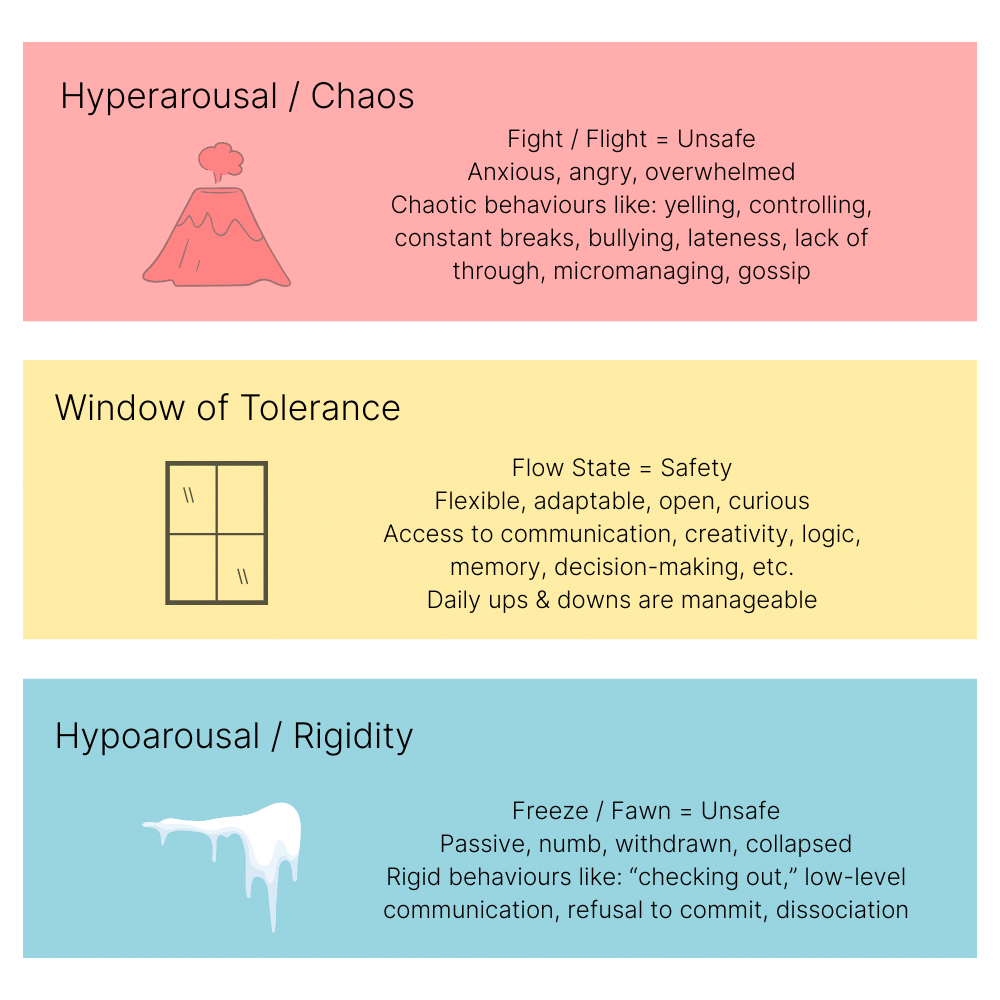
When leaders and teams understand the window of tolerance, we stop blaming people for being “difficult” or “checked out” and start creating conditions where everyone can operate at their best.

Why This Shift Matters
At its core, this is about capacity. The future of work isn’t just about smarter strategies – it’s about creating conditions where those strategies can succeed.
When organizations understand this, the training they invest in leads to lasting change.
What Organizations Gain
Organizations that embrace this approach will:


A New Framework For Leadership
This new era of work doesn't replace skills like communication, feedback, or inclusion – it makes them possible. When we have the capacity to stay present, and feel psychologically safe, we can:
In other words: this is the starting point for every other workplace skill. It's the bedrock upon which these core skills can be built.

We're confident the investment in this training will lead to more positive interactions
al rajan, mlse
Senior Manager, Learning & Development
MLSE invested in The Expert Talk to train our supervisors on Conflict Navigation and De-escalation. The goal was to ensure our supervisors had the tools they needed to not only find key ways to approach conflict, but to manage their own emotions while doing so and to employ self-care techniques after the conflict.
Right from the start their team was very responsive and did a great job in working with us to nail down the objectives. They provided us with an experienced and dynamic facilitator to lead our sessions. The Expert Talk was very flexible with dates and times which was key since our business doesn’t always operate within business hours.
We’re confident the investment in this training will lead to more positive interactions with our guests and ensure that our employees feel supported.

We call this the Nervous System Era of Work because it represents a fundamental shift in how organizations think about people and performance. It’s about moving from surface solutions to real, lasting change.
It’s not a call to tear everything down and start again. Far from it. This is a framework that strengthens what’s already in place. A new lens through which to look at ourselves, our teams, and the world around us. The bedrock of psychological safety.
The power of this framework lies in its simplicity: it's available right now, to every one of us. The strategies are simple, accessible, and can start creating shifts right away. They don’t require a new system or a massive overhaul – they start with us. Each of us already carries the most powerful tool for creating safety and connection: our own capacity.
The workplaces of tomorrow will be built by organizations that understand this simple truth: when people feel safe and like they belong, they can do their best work together. And that future begins with each of us, right now.
Did You Know?
Everything we do is grounded in trauma-informed practices. Sometimes we name them directly, like in our Trauma-Informed Leadership programs. Other times, they’re woven seamlessly into how we teach boundary-setting, collaborative communication, or conflict navigation. This flexibility means every organization benefits from the science and care of trauma-informed work – without needing to take on language they’re not yet ready for.
Ready to Experience the Shift?
Book a Call With Us Now!
721-304 Stone Rd W., Guelph, Ontario
Connect with us on LinkedIn

Useful links

